November 4, 2011 on Projects
An excerpt of my post about our new project on the WP innovations blog:

This is one of the first projects to take users opinions and mash them up with actual data to see whether perceptions match up with reality. It’s a fascinating window into how people feel about the places where they live and a forum for a conversation around how things are changing.
There are already some patterns emerging. We are starting to see that, in general, more states with high unemployment are being rated ‘worse’ by users, and more places with low unemployment are being rated ‘better’.
D.C. stands out – though unemployment is high, 83 percent of users (as of publication of this post) ranked it better. One left a comment after rating it ‘better’: “DC is better due to a higher number of permanent residents, community activism, and better stewardship. Welcome to the 21st century!” The comments on why people voted the way they did have been some of the most interesting results of the project we’ve seen so far.
Read more of this post at @innovations »
Posted by Kat Downs on Friday, November 4, 2011 at 12:28 pm
Tags: census, dankeating, Design and infographics, infographics, ugc, unemployment, usergeneratedgraphics, washingtonpost.com, Work
September 28, 2011 on Information Graphics
In an extremely quick turnaround, I worked with Dan Keating to create this tool that shows you the breakdown of what other people of your age, race, and location make each year. Hopefully in the future we’ll be able to improve it and add some more metrics, but it’s pretty cool for taking less than a day!

Posted by Kat Downs on Wednesday, September 28, 2011 at 9:37 pm
Tags: acs, census, charts, Dan Keating, data, income, infographics, The Washington Post
September 19, 2011 on Information Graphics

To create this graphic about exercises you can do at the office, the entire graphics department of the Post got together twice a day to do the exercises. It was a hilarious group activity — we attracted a lot of stares from passersby in the newsroom. I really enjoyed jumping around a little bit in the middle of the day to get the blood pumping.
The graphic was a fun collaboration between Laura Stanton, who illustrated many of the department members, Sohail Al-Jamea, who created the animations, Bonnie Berkowitz, who was our exercise leader and researched and wrote all the text and conducted the survey, and me — I helped design and build the interactive and set up the videos and polls.
So far we have had a lot of people voting — about 1,700 for the first exercise. It’s fun to see how people have responded to each exercise, and we’re hoping it is promoting engagement with the piece.
Posted by Kat Downs on Monday, September 19, 2011 at 11:51 am
Tags: exercise, games, health, illustration, interactive, laura stanton, Multimedia, polls, sohail al-jamea, video, voting
September 18, 2011 on Multimedia
With Kate and Will back in the news for the rumors about a pregnancy with twins (not true, by the way), I thought, “Hey, what better opportunity to make up for the fact that I never wrote about our royal wedding graphics on the blog?” So here I am. Royal couple junkies, enjoy. And if you’re a true royal wedding fanatic, you might enjoy this video about my roommate, coincidentally also named Kate Middleton (this one is true).
The main piece I worked on was the Westminster Abbey and parade route tour. Sohail Al-Jamea and Alberto Cuadra worked together on the 3-D renderings and animations, and I layered on the interactivity and created the Google Earth flyovers and, with help from Laris Karklis, the parade route maps and Street View layers.

Continue to see how we made the interactive parade route, and how we created 3 types of javascript quizzes »
Posted by Kat Downs on Sunday, September 18, 2011 at 9:42 pm
Tags: 3-D, features, fun, games, google earth, google street view, Karen Yourish, laura stanton, motion graphics, royal wedding, The Washington Post
September 18, 2011 on Information Graphics
Today, we came out with a new graphic that looks at the tax breaks on the books this year. It is part of Running in the Red, a series the Post has been running for the past few months, and accompanied Lori Montgomery’s front-page story, “Ever-increasing tax breaks for U.S. families eclipse benefits for special interests,” a great story that explains spending through the tax code.
The graphic is all CSS and JavaScript. With charts that only have bars, it’s simple to dynamically add sized divs with background colors that create charts. The data will update automatically if necessary and it works across all browsers and mobile platforms with no workarounds:

And has details for each of the 172 breaks currently active (see below). Added bonus: I learned a ton about the tax code.

And a couple more (relatively) recent charts:

This one I worked on with Alicia Parlapiano and Neil Irwin. Because I wanted to create animate transitions and interactivity, I used Flash to create this graphic. It has detailed drilldowns to look at employment in each sector of the economy. I tried to inject more annotation into this graphic (and the taxes one above) than we have done in the past with data-driven graphics. Instead of throwing a bunch of data out there, we’re providing more context and guided views — by category and by sector versus a completely self-guided data dive.

This was a fun chart I helped our intern, Heather Billings, with at the beginning of the summer. We used flot to make these charts showing how the lead changed between the Heat and the Mavericks during the NBA finals. This was particularly fun for me because I got really into the NBA finals this year and watched every game. I know, hard to believe, but true. I was a having a great time analyzing the outcome of the games and reading all the news — and if you missed it, this was a great article from Bill Simmons at Grantland.

And another one about when and if China’s economy will pass the United States to become the world’s largest.
Posted by Kat Downs on Sunday, September 18, 2011 at 8:20 pm
Tags: alicia parlapiano, basketball, charts, css, Design and infographics, heather billings, infographics, javascript, Karen Yourish, laura stanton, nba, politics, sports, taxes, The Washington Post, unemployment, Work
August 24, 2011 on Photography and multimedia, Travel
My first shot at iPhone photography. I found it really fun — I love the filters and the size of the phone makes it easy to carry around. I was mostly using Hipstamatic and Instagram, and shot a few panoramas with the Photosynth app. To see the full gallery, go here.
Most of these were taken in New Hampshire (Lake Winnepesaukee and Portsmouth), Boston, and Hendersonville, N.C. Here’s a shot of Mt. Major near Alton Bay, N.H. Click the image to enlarge.

Posted by Kat Downs on Wednesday, August 24, 2011 at 5:46 pm
Tags: filters, iphone, Photography and multimedia, technology, Travel
June 2, 2011 on Programming
Excerpts from a new post for WP’s @innovations blog:
[Go to the blog to read the whole thing]
When Apple announced early last year that it would not support Flash on the iPhone and iPad, a passionate conversation erupted in the world of web development: Was Flash dead? If not, how would it survive? When should it be used? News developers asked these questions as well, and, at least in our newsroom, the conversation inspired some thinking about how to approach interactive development. Over the past year and a half, there has been steady movement toward more interactivity based on JavaScript and fewer Flash-only experiences.

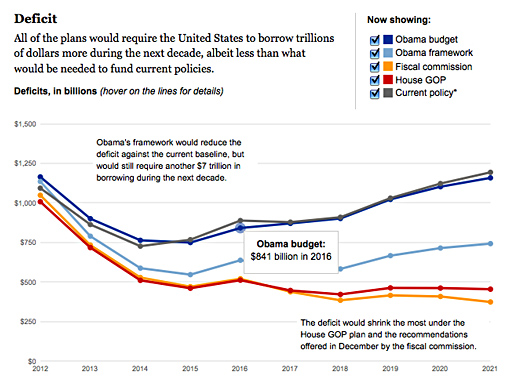
Last week we published a graphic that compared four federal budget proposals through a series of charts. We used the jQuery library Flot to draw simple, interactive line charts that showed how the debt and deficit would change under the different plans. Flot is very easy to use, flexible and customizable, and is one of many free-to-use JavaScript graphing libraries out there (Dracula, Highcharts and RGraph are a few others). We also built a customized chart with CSS and JavaScript at the bottom of the page to show how different categories of spending would be affected.
Read the rest of the article…
Posted by Kat Downs on Thursday, June 2, 2011 at 12:37 pm
Tags: articles, Design and infographics, Flash, graphics, interactive, javascript, programming, technology, washingtonpost.com, Work, writing
May 30, 2011 on Information Graphics

Photos: Malofiej 19 at the University of Navarra
In March, I set out for Pamplona, Spain, to join the jury of Malofiej 19. For three days, we judged hundreds of entries in the digital contest, while colleagues on the print side saw over 1,000 entries. Check out the awards here.
Other jury members came from all over the world — Germany, Argentina, Chile, Spain, Italy, and the United States. I met a ton of awesome people who share a passion for infographics and alternative forms of storytelling. Gert Nielson keeps a good log of the goings on at his blog, Visual Journalism. Kaitlin Yarnall of National Geographic wrote a summary piece for the Society of News Design blog here. Javier Errea, who organizes the event, also wrote a post on his blog (in Spanish).
I really liked Stephen Few’s presentation on Infographics and the Brain — reminding us all to think not only of how we want to present the information, but how it will be perceived. It doesn’t matter how good it looks or how clever we think it is if it misses the basic point: helping people understand information.
I gave my presentation on the power of using social media and user-generated content in graphics. I focused on two types of input — that which comes directly from our users (games, polls, submissions) and that which comes from existing social networks (facebook, twitter, foursquare, flickr). The amount of information out there is incredible, and we have to figure out how to use it in ways that show how people fit into their world. The opportunities are endless. Recently some interesting projects have come out that harness some of that power, including the Wall Street Journal’s Foursquare project, a look at check-ins over a week’s time in New York and San Francisco, and the New York Times Bin Laden emotion grid.
For more photos from Malofiej, go here.
Posted by Kat Downs on Monday, May 30, 2011 at 11:14 am
Tags: awards, conferences, Design and infographics, infographics, malofiej, Photography and multimedia, presentations